
Let the group find its way: a grade 5 lesson in facilitating conflict
One of the core beliefs behind my facilitation work is that the answers already exist within the group. The facilitator's job is to create the conditions for those answers to emerge. I did not have the words for that belief when I first experienced it. I was ten years old.
Class president
In 1979, my grade 5 teacher, Mr. McGee, decided we should learn how elections work. We formed two parties, and I was nominated to lead one. My best friend was my campaign manager and wrote a campaign song, "Shakky the Running Man," sung to the tune of a cartoon theme. We were ten. I won, formed a cabinet and enjoyed the attention. Looking back, I suspect Mr. McGee thought I was missing the point of the lesson.
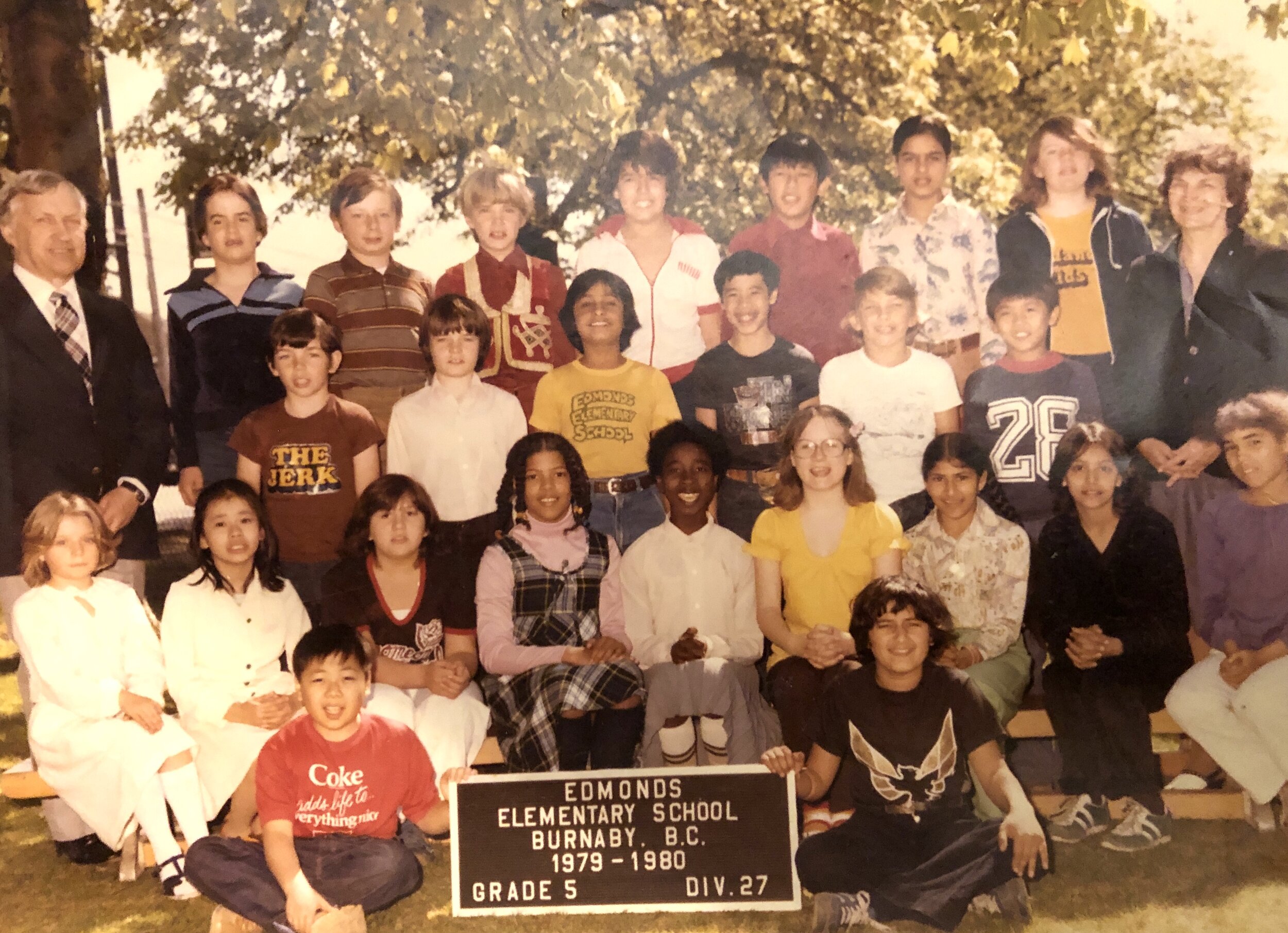
Mr. Burt McGee, on the left, was my grade 5 teacher and vice-principal.
The point arrived a week later, when he organized a class meeting for me to chair, with a few other teachers observing. The agenda went smoothly until "any other business." A girl raised a complaint about a boy she said was bullying, taking the ball during games and making the girls chase him. Then the floodgates opened. One complaint followed another, all about the same boy.
The complaints were not wrong. He had taken the ball. But something felt off. Classmates were snickering and nodding. Even one of the observing teachers, who had her own frustrations with this boy, was smiling. The meeting had become a pile-on.
Holding the room
Had I been sitting with the other students, I might have added a complaint of my own, or stayed quiet. But I was chairing. I had to decide how to steer the conversation.
I thought about my mom, the peacemaker of our family and of our extended family. Couples sometimes came to our home in the evenings to seek my parents' advice on their conflicts. My dad usually led those conversations, but it was my mom who made the difference.
So I tried to do what she would do. I turned the conversation toward how we wanted to treat each other and resolve conflict as a class. Together we created three or four "guiding principles," though I certainly did not know that phrase at ten. And it turned out the boy we had been calling a bully had legitimate concerns of his own that we needed to hear. Things were not perfect afterwards, but they improved, and he turned his behaviour around for the rest of the year.
What stays with me most is what Mr. McGee did not do. When the conversation grew tense, he could have stepped in. He did not. He let me, and the class, find our way through it.
The lesson I still use
I have facilitated versions of that conversation many times since, with leadership teams working through tension, disagreement and questions about how they want to treat each other. Whenever a group is tempted to solve a sensitive issue with a presentation, I think back to that grade 5 classroom. People change how they work together when they shape the agreements themselves, not when they are told what the agreements should be. The flip charts and sticky notes are newer. The principle is the same.
What this means for leaders and teams
- Resist the urge to rescue. When a conversation gets tense, the leader's instinct is often to step in. Sometimes the most valuable thing is to hold the space and let the group work.
- Watch for the pile-on. When a group converges quickly on one person or one view, it is worth asking whose perspective is missing.
- Shift from complaints to agreements. Asking "how do we want to work together?" moves a group from blame to shared commitments.
- Co-create, do not present. People own the norms they help write. A workshop will usually achieve more than a presentation.
To learn more about my approach, see how I design facilitation.
Questions to reflect on
- When did someone trust you to work through a difficult situation yourself, and what did you learn?
- In your team, whose perspective might be missing from the conversations that matter most?
This post is part of the Defining Moments series. A version of this story first appeared on shakeelbharmal.com.